OctoSplat: Hybrid OctoMap-Gaussian Splatting for Active Semantic Mapping and Phenotyping with Horticultural Robots
Abstract
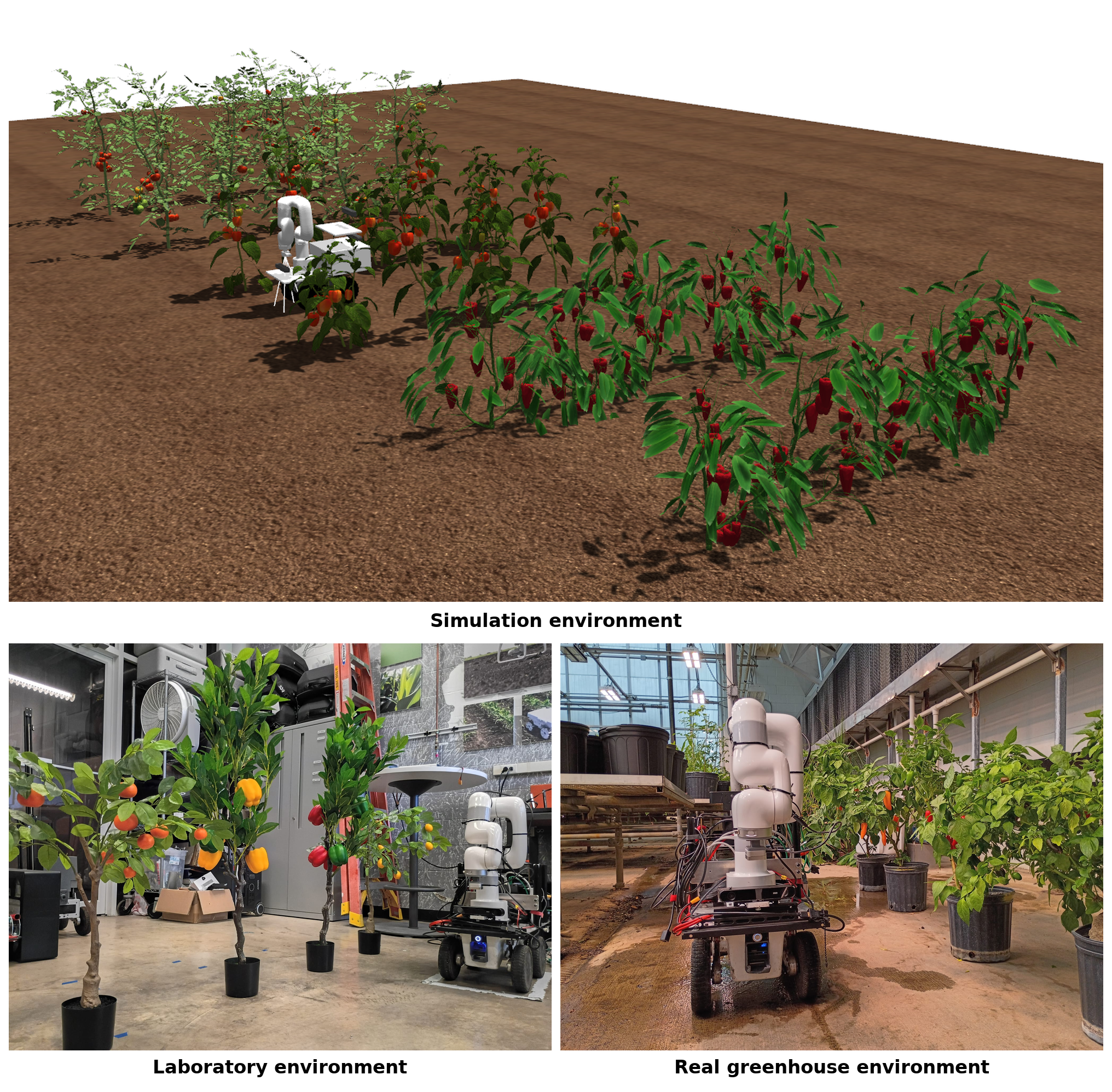
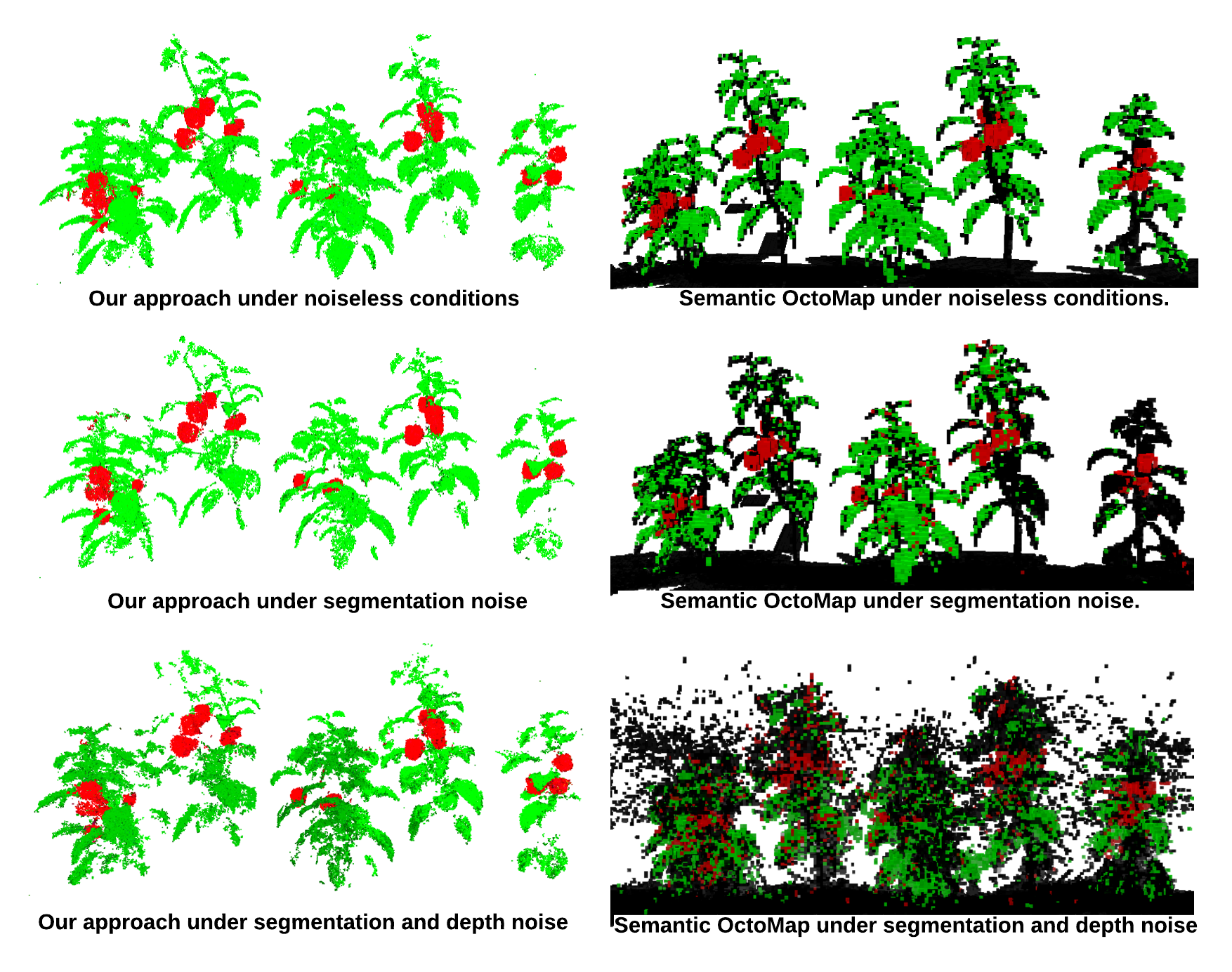
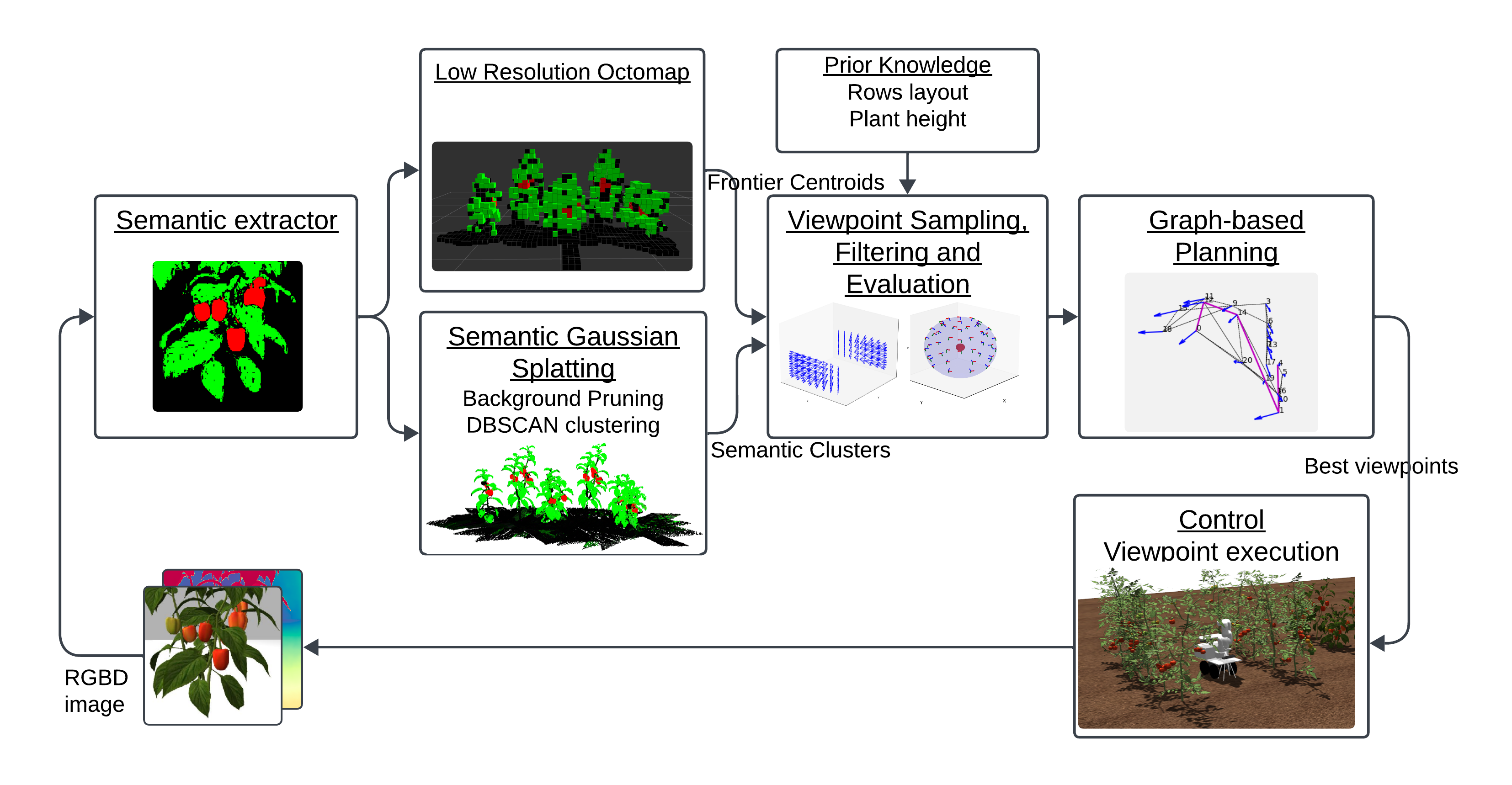
Semantic reconstruction of agricultural scenes plays a vital role in tasks such as phenotyping and yield estimation. However, traditional approaches that rely on manual scanning or fixed camera setups remain a major bottleneck in this process, and existing active-mapping methods based solely on occupancy grids are too coarse to support accurate trait estimation. To close this gap, we propose an active 3D reconstruction framework for horticultural environments using a mobile manipulator. The proposed system integrates the classical OctoMap representation with 3D Gaussian Splatting to enable accurate and efficient target-aware mapping. While a low-resolution OctoMap provides probabilistic occupancy information for informative viewpoint selection and collision-free planning, 3D Gaussian Splatting leverages geometric, photometric, and semantic information to optimize a set of 3D Gaussians for high-fidelity scene reconstruction. We further introduce a robust mapping strategy that mitigates the effects of semantic segmentation and depth noise, together with a background pruning method that reduces memory consumption and computational cost. We validate our framework across simulated, laboratory, and real greenhouse scenes, and show that the improvements hold consistently across three state-of-the-art Gaussian Splatting backbones. In simulation, where ground-truth geometry is available, our approach outperforms occupancy-based mapping in both reconstruction accuracy and runtime efficiency: compared with a 0.01m-resolution OctoMap, our method doubles the fruit-level F1 score under noisy conditions while achieving up to a threefold reduction in runtime. Beyond simulation, novel-view synthesis quality also improves consistently in the laboratory and real greenhouse environments, with PSNR and mIoU improving by up to 1.5 dB and 18% respectively. Finally, the reconstructed semantic maps enable fruit counting and volume estimation with accuracies approaching 80%.
Method
Results